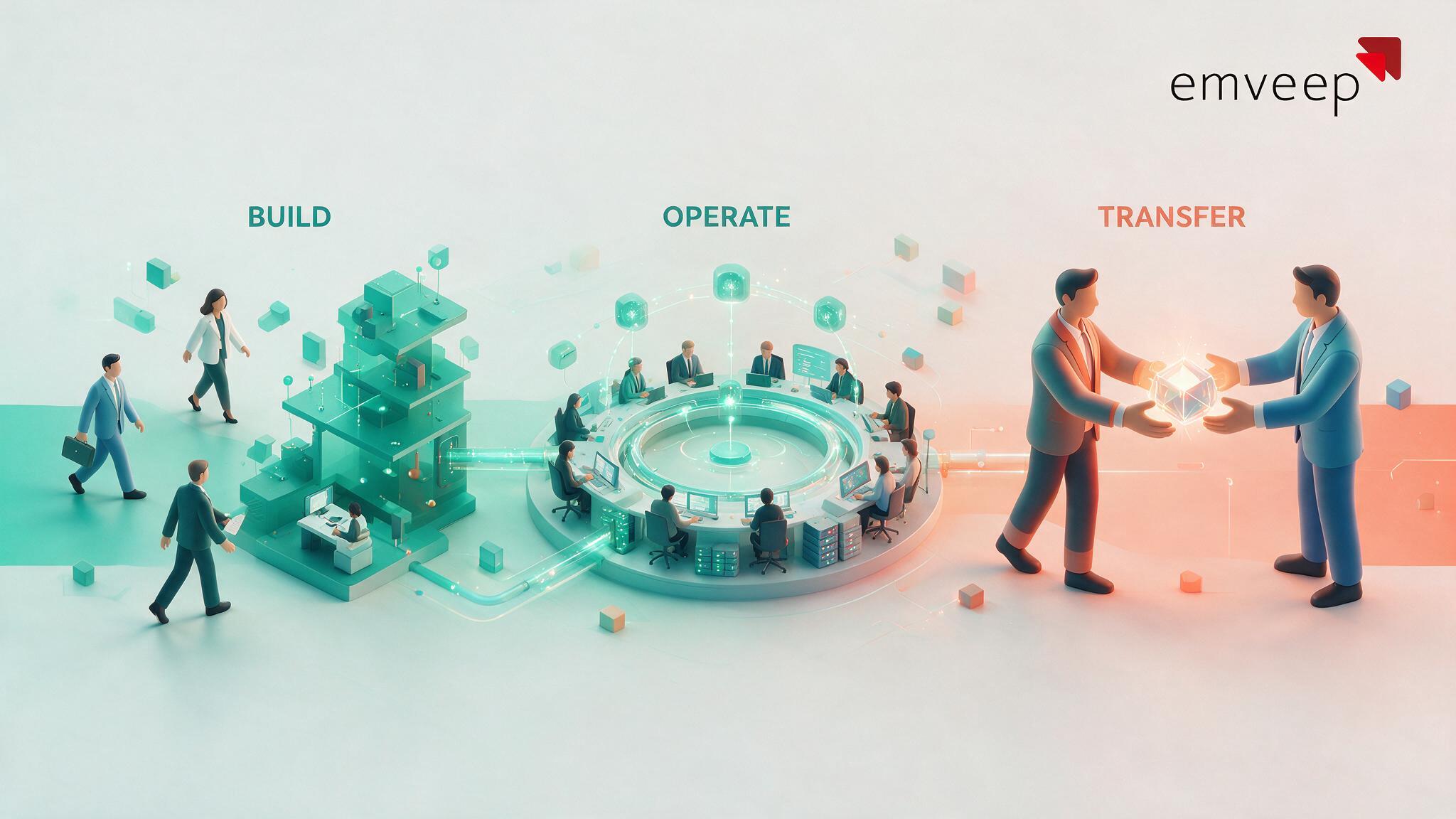
Somewhere between renting a team and building your own offshore subsidiary sits a model that’s become increasingly standard in 2026: Build-Operate-Transfer, or BOT. It’s designed for companies that eventually want their own offshore development centre but don’t want to shoulder all the risk and hassle of setting one up from scratch in a country they don’t know.
Build-Operate-Transfer is a phased model where a local partner builds your offshore team and operations, runs them until they’re stable and performing, and then transfers full ownership to you. You end up owning the team and entity outright — but you skip the painful, risky early stage of figuring out hiring, compliance, payroll and culture in an unfamiliar market.
How the three phases work
The clue is in the name:
- Build: the partner recruits the engineers, sets up the office, infrastructure and legal/operational scaffolding, using their local knowledge to move fast and avoid the classic mistakes.
- Operate: the partner runs the team day to day — delivering your work while the operation matures, processes bed in, and performance becomes predictable.
- Transfer: once it’s stable, ownership passes to you. The team, the entity, the operation — it becomes your captive offshore centre, staffed by people who already know your product.
Why it’s gaining ground
BOT solves a specific tension. Setting up your own offshore development centre gives you maximum control and the best long-term economics — but doing it cold, in a foreign jurisdiction, is genuinely hard and risky. Hiring, local labour law, tax, culture and retention all have traps that cost outsiders dearly. BOT lets a partner absorb that risk during the fragile early period, then hand you a working operation. You share the risk, then own the reward.
It also produces continuity that pure project outsourcing can’t. Because the same team carries through all three phases, the product knowledge they build isn’t lost at transfer — it comes with them. That’s a big deal for anything mission-critical.
When BOT makes sense (and when it doesn’t)
BOT is a strong fit if you have a long-term horizon, expect to want a sizeable offshore presence, and value eventually owning that capability outright. It’s overkill if you just need a few engineers for a defined stretch — in that case an extended team is simpler and cheaper. The rule of thumb: BOT is for companies building a permanent offshore chapter, not for filling a temporary gap.
The questions to ask a BOT partner
If you’re considering this route, press on the details that determine whether the transfer will actually go smoothly: How is the transfer priced and triggered? Who owns the IP and the employment relationships at each stage? What happens to key people at handover, and how is retention protected? A credible partner has clear answers; the transfer terms are the whole point, so they shouldn’t be vague.
Emveep operates from established studios in Bali and Bandung with deep local hiring and operational knowledge — the foundation a BOT engagement is built on. If you’re thinking about a long-term offshore centre and want to de-risk the setup, let’s talk through whether BOT or a straightforward extended team is the better path for you.